Wednesday, May 21, 2014

Cognitivism in Practice

                 What we see, hear, smell, taste and feel are all the senses we use to take in information and when people experience similar experiences we say to ourselves that we have done this before.  There are times where we know instantly whether we did this before and it isn't until we are in the act of a previous experience can we confidently say that definitely done it before.  On some occasions we even compare a new situation to a past one and simple use the skills gained into the new situation.  A cognitive learner, which I would say is many of us, uses their senses to store into short term memory and make connections to store into long term memory.  Dr. Orey discusses how a leaner could tie General Lee to the Civil War by making connections to Lee jeans they like to wear or General Lee the nickname of the iconic muscle car of The Dukes of Hazard (Laureate Education Inc., 2014).  Using prior knowledge to make connections can really help to trigger new information being learned through reinforcement or practice.  
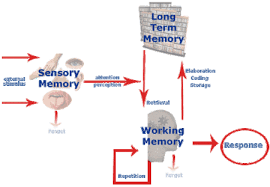
                 Every individual learner will experience learning in different ways and organized forms of information are important to learn efficiently.  In the observation of the 8th grade math class, where the students were asked to use excel spreadsheets to analyze the results of their calculations displayed a great example of creating a new applicable experience that uses technology to help cognitive learners (Laureate Education Inc., 2014).  Students in the class were able to review their prior knowledge of addition and subtract while applying it an excel spreadsheet to analyze the results.  The excel spreadsheet helped the students to focus mainly on the statistics of their results rather than the computation of the numbers.  The activity is an effective way to have students review, learn through prior knowledge and critical thinking to reach a higher level of learning.  Students used an advanced organizer to learn and complete the task the teacher had structured around technology.  

                 Using advanced organizers like google docs to take notes or store information can help students to rehearse knowledge to store into their long term memory (Pitler, Hubbell & Kuhn, 2012).  I have always felt that questioning is a effective form of assessment that keeps students engaged while reinforcing the information that is being given.  

Click here for the interactive concept map.


References:
Orey, M. (Ed.). (2001). Emerging perspectives on learning, teaching, and
            technologyRetrieved from http://projects.coe.uga.edu/eplt
            t/index.php?title=Main_Page
Laureate Education (Producer). (2014). Cognitive learning theories [Video file].
Retrieved from https://class.waldenu.edu
Laureate Education, Inc. (Producer). (2011). Cognitive learning theory. 
         Bridging learning theory, instruction and technology. 
          Retrieved from https://class.waldenu.edu
 Pitler, H., Hubbell, E. R., & Kuhn, M. (2012). Using technology with classroom
          instruction that works (2nd ed.). Alexandria, VA: ASCD

Wednesday, May 14, 2014

Behaviorism in Practice


           Motivation always seems like something teachers need to instill into our students to keep them interested in topics they may have little interest towards.  Many of the students that I have come into my classroom with very little motivation to do mathematics, so I begin my school year with many skill building lessons and activities for students to gain confidence through achievement that is reinforced on a regular basis.  Assigning homework and completing assignments successfully can help students gain the confidence needed to learn mathematics because of the trial and error learning curve.   The repetition of applying mathematical concepts through challenging examples with immediate feedback of success is important for students to experience.  Giving assignments and homework to students "...provides oppurtunites for students to familiarize thenmmselves with new concepts as well as to practice, review and apply what they've learned"  (Pittler, Hubbell, & Kuhn, 2005, p. 167).


Charts detailing student achievement on quizzes and effort seems like a great way to reinforce the motivation to continue working hard while recognizing success (Pittler, Hubbell, & Kuhn, 2005).  Being able to present a chart that correlates student achievement to student effort reminds students of their progress and how it can positively affect their academics.  Reinforcing desired behavior through the presentation of graphs and charts that notes their progress in real time.  Informing your students of their progress and what more they can do to be successful in the class gives students the opportunity for immediate satisfaction to continuously trying harder.
  
Behaviorists learn through positive and negative reinforcement, the charts, graphs, and homework assignments give educators the opportunity to give reinforcement.  Students can feel a sense of achievement through the completion of short tasks that they are able to accomplish.  In my own classes, I assign homework assignments every day for my students where they will also display the work.  


References
Pitler, H., Hubbell, E. R., & Kuhn, M. (2012). Using technology with classroom instruction that works 
             (2nd ed.). Alexandria, VA: ASCD.  

Friday, April 25, 2014

Final Blog Posting

                        To create a successful learning environment for our students takes many different things working in harmony.  Educators need to be able to pull all the factors together so that our students are able to use the many resources available to them.  Our face paced society and work ethic has created wonderful opportunities for students to create, to research and to apply their skills through technology.  Using blogs, podcasts, instant messaging, and wikis can help teachers transform the classroom into a forum that our students are familiar with. 
                         Taking the course Understanding the Impact of Technology on Education, Work, and Society at Walden University has helped me develop my own technological skills as a professional teacher by infusing technology into my lessons. Using my interactive whiteboard in other ways besides a presentation tool has helped me inform my students that the internet and resources online can be used for educational purposes then just entertainment.  My knowledge of teaching and learning processes has deepened through multiple points of entry for student understanding of a particular subject through technology.  Creating many forums for our students to express and receive ideas can only help our students to become successful.  Giving our students dynamic ways to obtain the information we need builds different skills for them to develop.  Seeking information and distinguishing what is important to achieve our goals will help our students to build critical thinking skills.  I have always thought that teachers did all the teaching and that students only learned from the instruction by the teacher.  After taking this course, it is clear that resources can be made available to our students so that they can learn from their peers and other resources that already exist all over the internet.  I will continue to expand my knowledge of learning, teaching and leading with technology with the aim of increasing student achievement through acknowledging how my students receive their information and providing pathways to be successful.  I will try to keep reading and looking out for different resources that our students to access when they are in school or at home. 
                       I will strive to incorporate a new technology every year to see what works best for my students to be successful through the different ways they can learn the material.  Being able to take my students to a computer lab in school once a week can help them become familiar with the different resources to use and apply to their school work.  Scheduling time to use the computer lab with my school will give my students opportunities to build skills that will help them research and come up with their own solutions.  Another long-term goal is to setup and a live interactive classroom that will inform students of their progress as the school year carries on.  Using my schools online website can help me create accounts for all my students to view which assignments they have completed and what they still need to complete to become successful in the classroom. 

                       Providing students with multiple and varied opportunities for using technology tools and resources to support learning has changed from rarely to often because of the different ways I can reach out to my students through the various resources the internet provides us.  Model effective and appropriate technology use in my work environment by using appropriate tools in work processes, such as communication tools, grading software, and online resources for teaching and assessment went from rarely to often after this course because of the different ways we learned to reach out to our students through different forms of media.  We can use online resources to inform and apply their learning to games or other interactive software to motivate our students to learn.  

Sunday, April 6, 2014

Trying to Podcast for the first time!

I listen to a handful of podcasts myself and I have always wondered how difficult it was.  Publishing a podcast myself for the first time was very interesting because of the different ways we can use technology to communicate ideas over computers.

A link to my podcast click here
http://dyam531.podbean.com/2014/04/06/student-response-to-their-access-to-technology/?token=15f143140a45ecb7bf69aee9fd9717f9

Sunday, March 30, 2014

Partnership for the 21st Century Skills...Necessary?


These days everyone owns a computer, laptop, tablet, smartphone or some kind of electronic device that delivers news and information to their finger tips.  News spreads as quickly as the person who's typing it and some of these people can type very quickly like some of my students.  Students have access to so much information that it can almost feel like 'information overload' when they sit through an entire day of learning while taking in the day's worth of social media.

This week I was asked to check out a website called The Partnership for the 21st Century Skills and it seems like another case of 'information overload'.  It is a website that students, parents, educators, community members and politicians can view and understand the purpose of implementing new standards into our education system.  It gives us resources and links to other websites that describe the standards and the various things it wants educators to teach our students.  I believe that a new learning standard is being implemented without a proper way to integrate it to reach the goals the website describes.  

Teachers in my school have been asked to implement a new curriculum that the state cannot afford because of the cost of the new textbooks and materials needed to convey the visions of the Common Core.  How is this fair for our students?  I have always been told throughout graduate school to not reinvent the wheel, it seems that there is a school of thought that believes that reinventing the wheel is the way.  

Thanks for reading.

Reference


Partnership for 21st Century Skills. (n.d.). A report and mile guide for 21st century skills. Washington DC: Author. Retrieved from http://www.p21.org/     

Sunday, March 23, 2014

What wonders a Good Blog can do!

Setting up a resourceful blog for my students can create multiple learning opportunities for them to use outside the classroom.  Catering to students needs is the most important thing so that a class website will be useful to them.  Creating a blog for my 11th grade Algebra2/Trigonometry class would be beneficial if I can implement the following:

-Posting a section for assignments and access to the material would benefit students who happen to miss class or those who misplaced the assignments.

-Creating a section for students to post pictures of solutions to view and conjecture about other students' work.

-Sharing links to websites that students can access additional material and other tech resources to enable students to complete tasks.

-To make it App friendly for students to access on their smartphones so posting pictures of math solutions for viewing can be shared.

Students who find it helpful and resourceful will keep them interested and viewing the blog.

Sunday, March 16, 2014

Bloggin' in Class!

Using a blog site for students can give opportunities for discussion, give suggestions, and ask questions about the topic they are learning.

It can be a great way for students to view assignments, post resources, view resources and preview future assignments in the course.

Blogging can be made accessible for students to view as long as they have a mobile smart phone.

Using a blog will create an area for students to seek extra help when they feel like extra help is necessary.  I believe that anything used to help students outside the classroom to remind them about their work will be beneficial to their success.